On this page
This is part 5 of Fabric Live, a series that builds an F5 BIG-IP lab on a SONiC EVPN fabric and configures it live on camera. Each part goes with a video on the LevelUP I.T. YouTube channel. How the lab itself is built (one file of values, up.sh, the SONiC EVPN fabric, the Palo Alto firewall, the three BIG-IPs and the validation) is covered in the first video, Fabric Live 1. Part 4 built the streaming telemetry: Telemetry Streaming into Prometheus, syslog into Loki, and a Grafana dashboard. This part puts an AI agent on top of that telemetry and lets it act on the BIG-IP pools.
A web server stops answering. The BIG-IP's health monitor notices and takes the member out of load balancing. But who decides what happens next: leave it, force it offline, bring it back when it recovers? And what about a server that is not dead, only slow, which the monitor still calls healthy? In this part a small program with a language model at its centre watches the three BIG-IP pools of the lab, investigates with the same data sources as the dashboard, explains what it found, and changes a pool member's state: first only after an operator types y, then on its own, inside rules written in code that the model cannot get past.
What you'll learn
- Why the detection is plain code and the model is only woken when there is something to think about.
- How tool calling works with a local open-weight model in Ollama: the request, the structured reply, the turn loop.
- The five tools (four that read, one that acts), the system prompt, and why tool design matters as much as the model.
- The guardrails, enforced in a function the model cannot argue with: only three actions, never the last available member, one action a minute per pool.
- Ask mode on a stopped server and guard mode on a slow one, with every terminal line and every logged tool call from the recording.
- Where the time goes, how the agent fails, and what a production version would need.
What this agent is, and what it is not
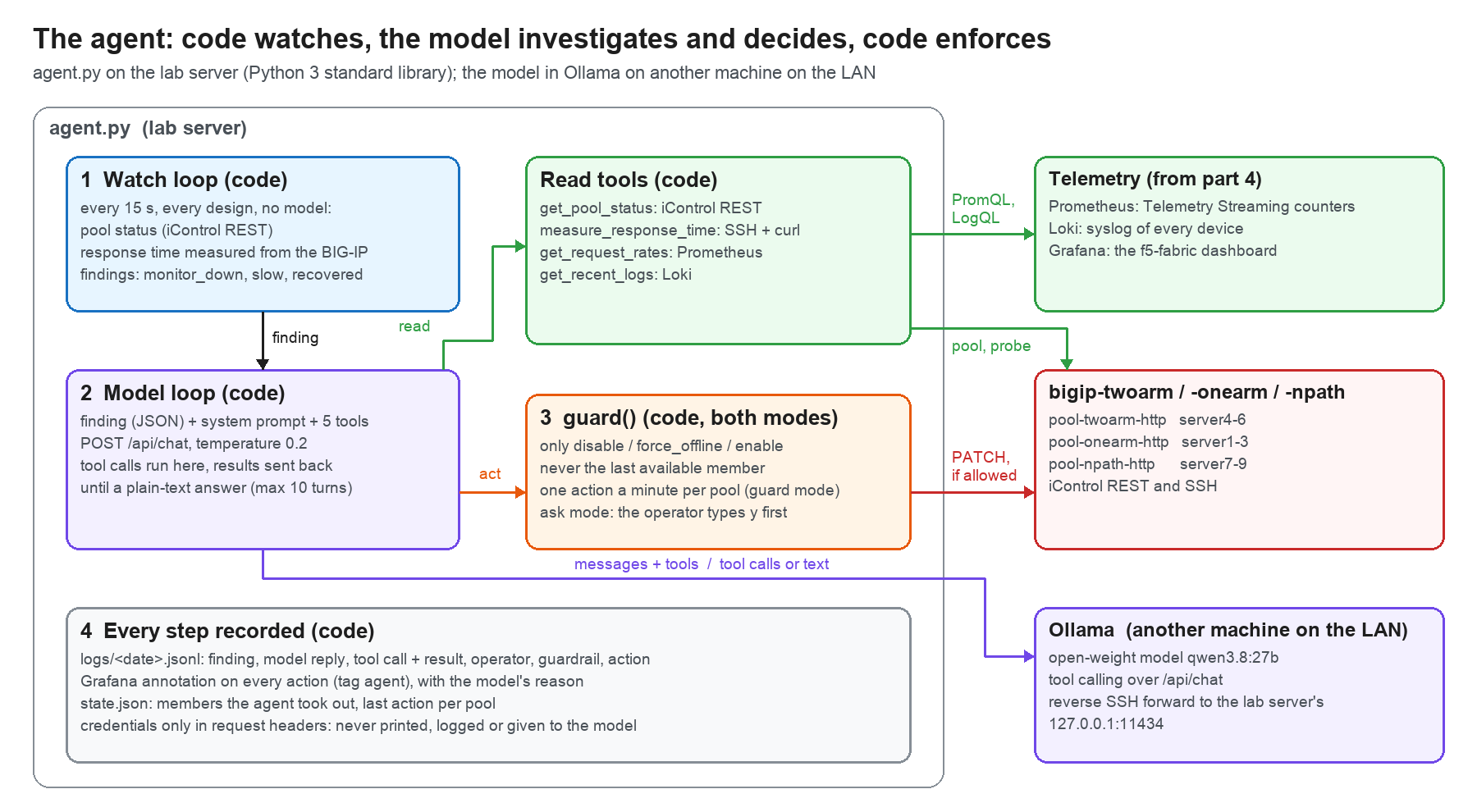
It is not a chatbot with access to the network. It is a Python program, agent.py, that uses only the Python 3 standard library and runs on the lab server. Most of what it does is ordinary code. Every 15 seconds it reads every member of the three pools through the BIG-IP's REST interface (iControl REST) and measures how long each server takes to answer, measured from the server's own BIG-IP. Only when that code finds one of three conditions does it call the language model, and hand it the facts.
The model's job is narrow: investigate with the tools it is given, decide what to do, and explain why. It never runs anything itself. When it wants to read or change something, its answer is a structured request to call one of the program's tools, and the program runs it. Everything that touches a BIG-IP goes through the program, which checks every action against fixed rules before carrying it out.