On this page
Two data centres, one tenant, and the request that always arrives on a Friday: the app team wants the same subnet in both sites so they can move workloads without re-addressing. You have Nexus 9000 in both halls, a pair of routers between them, and a Nexus Dashboard cluster that already manages nothing. This post builds the whole thing in Nexus Dashboard 4.1(1g): two VXLAN EVPN fabrics with eBGP underlays, an inter-site network on two core routers, an EVPN Multi-Site domain on top, and one network stretched across both sites. Every screen below was captured on the lab controller while the build ran, every command output is quoted from the recorded run, and the last section proves it with pings between hosts in different sites.
The click sequence is the same one you would follow on real hardware. The lab differences are the switch model, N9K-C9300v under containerlab, and the fact that the hosts are single-homed containers.
Lab Topology
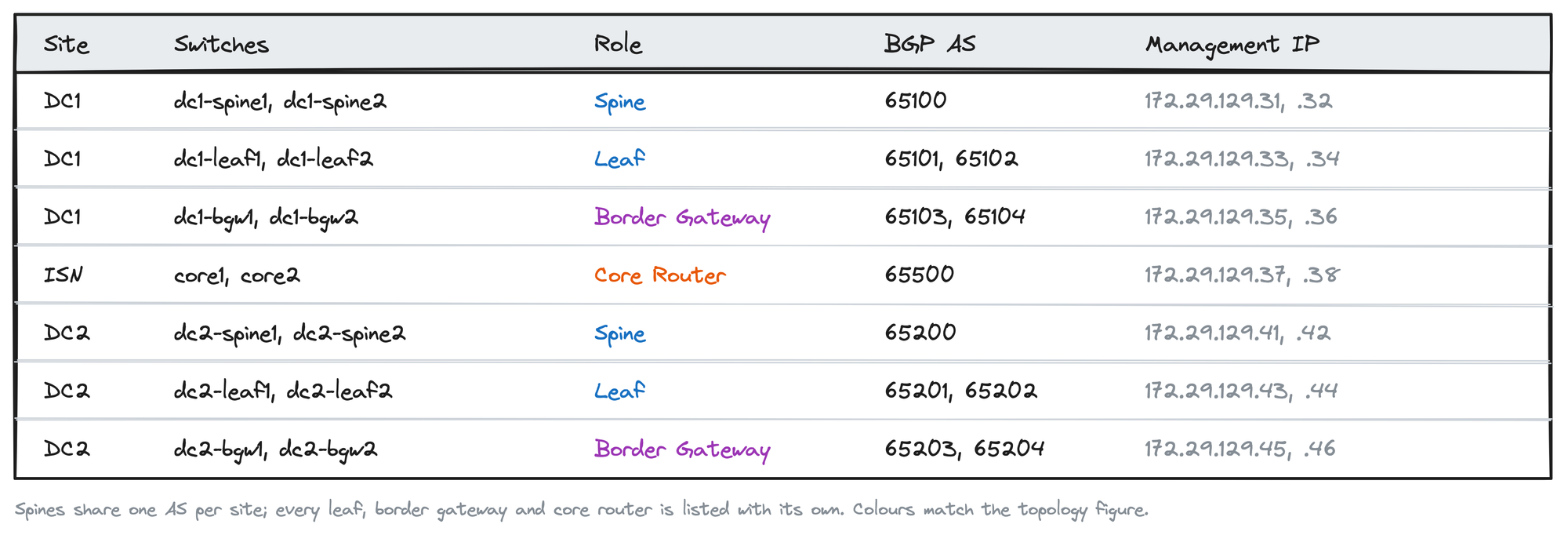
Each site has two spines, two leaves and two border gateways. The two sites meet on core1 and core2, which form the inter-site network, or ISN. Every border gateway connects to both cores, so each site has four links into the ISN. Each leaf has one host on Ethernet1/3, and all four hosts sit in the same subnet, 192.168.100.0/24, with the anycast gateway at .254 in both sites.
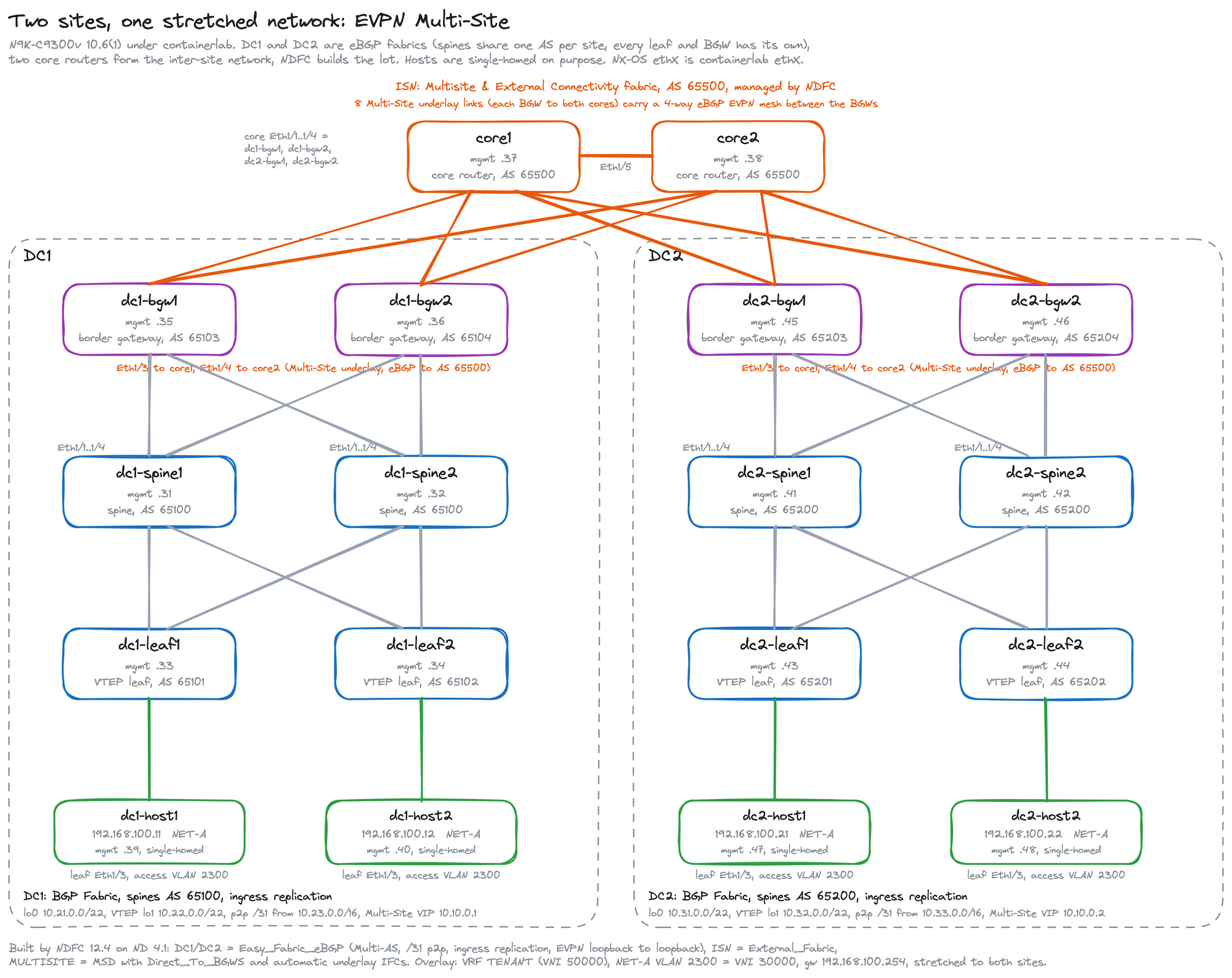
The routing design follows the eBGP pattern I use everywhere: the spines of a site share one autonomous system, and every leaf and border gateway gets its own. The underlay runs on /31 point-to-point links, and the EVPN overlay is an eBGP session from each leaf and border gateway loopback to each spine loopback. Inside a site, BUM traffic uses ingress replication.